
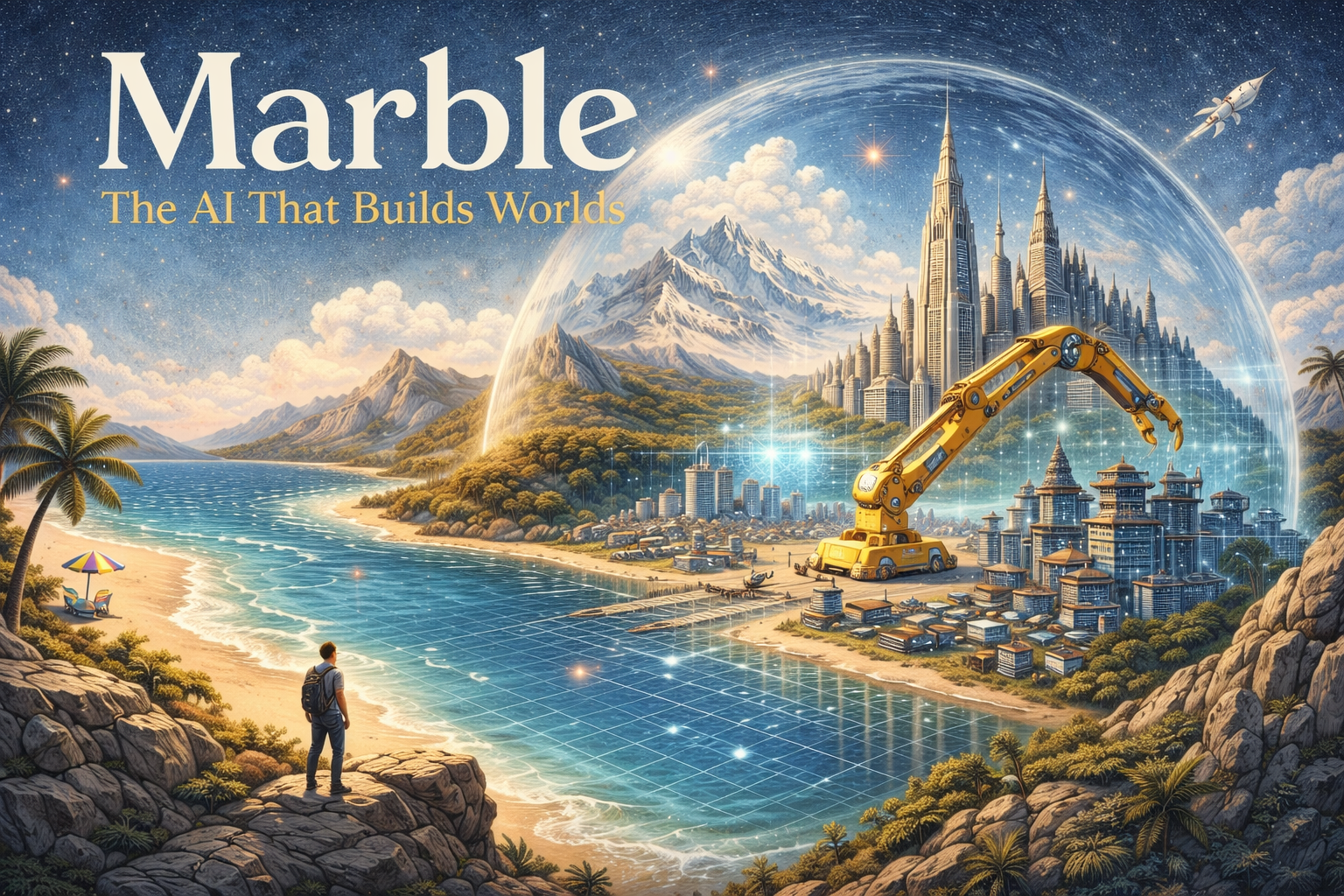
World Labs’ Marble is part of a new category of AI called world models—systems that can generate explorable 3D environments from text, images, or video. This article expands on Episode 1 of The First Morning Wave with extra context, examples, and practical implications across industries.
A New Category of Artificial Intelligence
In recent years, AI has advanced rapidly in language and image generation. Large language models can write, summarize, and reason with text. Image models can generate striking visuals from short prompts. But a different kind of breakthrough is now emerging—one that moves beyond text and images and into space itself.
That breakthrough is Marble, an AI system developed by World Labs, the startup co-founded by renowned AI researcher Fei-Fei Li. Marble belongs to a new category known as world models— AI designed to understand, generate, and interact with three-dimensional environments.
Rather than producing flat outputs, Marble creates explorable worlds. This marks a meaningful step in AI’s evolution: from systems that describe the world to systems that can construct and simulate it.

World Labs and the Vision of Spatial Intelligence
World Labs is built around an ambitious idea: spatial intelligence. Humans rely on spatial reasoning constantly— navigating cities, arranging rooms, understanding scale, and imagining how a space might change. World Labs aims to bring a version of that ability to AI systems.
Fei-Fei Li is widely recognized as one of the most influential figures in modern AI. Her work on ImageNet helped launch today’s computer-vision era and enabled machines to recognize visual information at scale. With World Labs, the focus shifts from “machines that see” to “machines that understand 3D space.”
The shift from generating content to generating environments is a major turning point: AI isn’t only describing reality anymore—it’s learning to build it.
What Is a World Model?
To understand why Marble matters, it helps to distinguish between the types of AI most people already know:
- Language models operate in text space (they predict and generate sequences of words).
- Image models operate in pixel space (they generate images from prompts).
- World models operate in spatial space (they model environments as coherent, navigable structures).
A world model doesn’t just generate a visual impression. It represents geometry, scale, orientation, and spatial relationships: walls connect to floors, doors lead somewhere, and objects exist in relation to one another. In practical terms, the output is not a picture—it’s a place.
How Marble Works in Practice
Marble is designed to work with a wide range of inputs: short text descriptions, single images, multiple reference images, short videos captured with a phone, and even rough 3D block layouts. From these inputs, Marble generates a coherent 3D environment that can be navigated, edited, and exported.
What makes Marble especially interesting is its emphasis on iteration. Instead of treating generation as a one-shot “wow” moment, Marble supports creative workflows where environments can be refined: layouts adjusted, objects replaced, visual styles changed, and scenes re-imagined without starting from zero.
For teams building interactive experiences, being able to export generated environments into tools like Unreal Engine and Unity is a practical bridge from exploration to production.

Implications for Game Development
Game development is one of the most immediate beneficiaries of world models. Traditionally, building 3D environments requires large teams, long production cycles, and extensive manual work. Even early prototypes can take weeks to assemble.
World models compress that early stage. Designers can generate environments rapidly, test layout ideas faster, and iterate visually rather than abstractly. This doesn’t replace artists or designers—it compresses the timeline so teams can spend more time polishing gameplay, story, and feel.
For indie developers, this shift can be especially significant. Lower environment-production costs can unlock more experimentation and more niche game concepts that previously wouldn’t justify large budgets.
Industrial and Robotics Applications
In industrial environments, small changes can have large cost implications. Testing those changes in the real world is expensive and disruptive. With world models, organizations can recreate production floors digitally, simulate process timings, evaluate layout changes, and test how new machines fit into workflows.
For robotics, world models can provide realistic training and testing environments. Robots and AI agents can practice navigation and coordination in simulated spaces before operating in physical ones. This “simulate first, deploy later” approach reduces risk and can accelerate innovation.
Architecture and Real Estate
In architecture and real estate, Marble introduces a new way to visualize and communicate space. A short video or set of reference images of a property can be transformed into a navigable 3D model. Designers can then explore alternative layouts, materials, and lighting conditions—without expensive mockups.
For clients and investors, this replaces abstract plans with experiential understanding. Instead of guessing what a renovation might feel like, people can explore options virtually and make better decisions earlier in the process.
Science and Engineering
In science and engineering, physical prototyping can be slow, expensive, and sometimes risky. World models add a complementary layer of experimentation: virtual testing of configurations, scenario exploration under controlled conditions, and comparisons of outcomes without material costs.
While Marble is not yet a high-fidelity physics simulator, it points toward a future where spatial simulation becomes standard in research and development workflows. As world models evolve, they could become foundational tools for experimentation across disciplines.
Education at Every Level
Education is another area where world models could have meaningful impact. At introductory levels, students can explore historical environments, scientific structures, or architectural spaces rather than learning purely through static diagrams.
At higher levels—universities, research programs, and professional training—world models can support immersive learning in fields such as engineering, medicine, robotics, archaeology, cinema, and the arts. Complex systems become environments you can step into, not just text you read about.
Evidence from Real-World Use
Marble is already being explored in real projects and experiments:
- Gaussian Mansion — an AI-generated environment imported into Unreal Engine as an explorable space.
- Rosebud AI — rapidly generating multiplayer-ready worlds for interactive experiences.
- Escape.ai — converting cinematic scenes into walkable 3D environments.
- VIVERSE (HTC) — accelerating VR environment creation workflows.
Tip: add outbound links to these projects (or official posts) once you have them, to increase trust and reader engagement.
Limitations and Open Questions
Despite its promise, Marble is still early. Generated environments often require cleanup; physics modeling remains approximate; and visual styles can vary in consistency. There are also important questions around creative ownership and how AI fits into human production workflows.
A balanced view matters here: world models are advancing quickly, but they’re not “magic.” They are powerful tools that will likely become more useful as workflows, datasets, and integration standards mature.
Looking Ahead: From Words to Worlds
For years, AI progress has been measured by how well systems talk, write, or generate images. World models suggest a new direction: AI that can construct environments and simulate spatial relationships.
In the long term, world models could become experimental platforms for science, creative canvases for artists, learning spaces for education, and simulation environments for engineering and robotics. Marble looks like an early step toward that future—and its most impactful applications may be the ones we haven’t imagined yet.
Want the Audio Version?
This article expands on The First Morning Wave Episode 1. If you prefer audio, follow the show on Spotify and stay tuned for weekly episodes. For more AI and tech updates, visit our News section: surfwebsol.com/news.